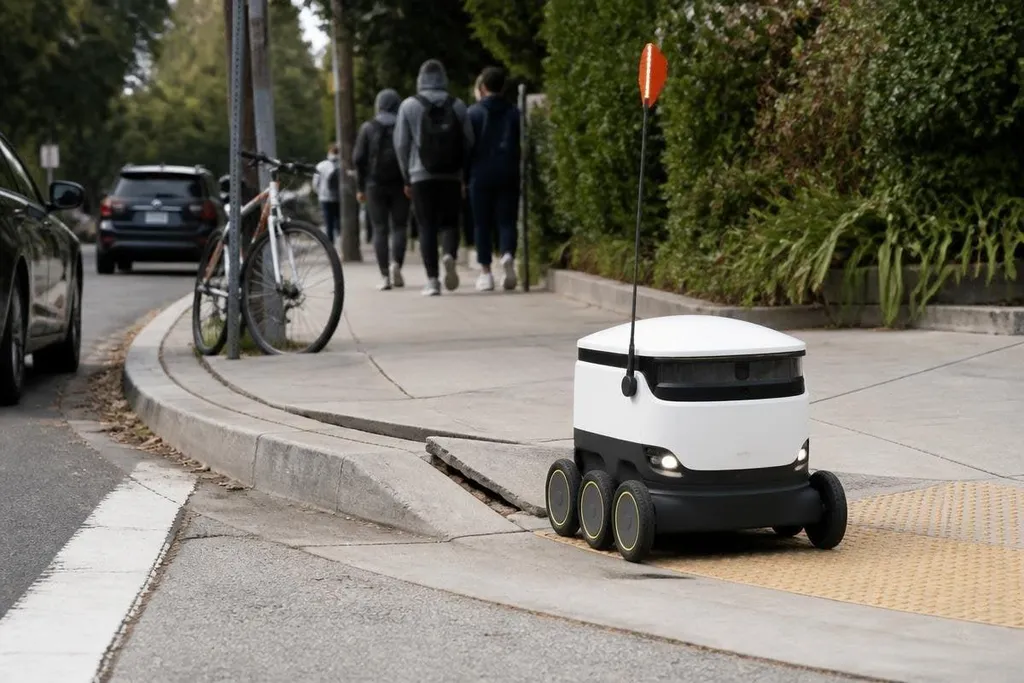
A delivery robot can travel for miles and still fail at one curb ramp. That small gap explains why sidewalk robotics is a harder engineering problem than a map and four wheels suggest.
- The hard part: crossing streets, ramps, driveways, and crowded paths without blocking people
- The hidden system: cameras, LiDAR, geofencing, and remote operators work together
- The buying test: count human interventions, damaged orders, and completed trips
Sidewalks are not roads
Roads have lanes, signs, and rules built for vehicles. Sidewalks change from one property to the next. A delivery robot may meet a cracked pavement edge, a parked bicycle, a temporary sign, or a group that fills the whole path.
That forces the robot to do more than follow a route. It must detect objects, estimate open space, choose a safe speed, and stop when the path closes.
LiDAR measures distance with laser pulses, while cameras help classify objects such as people, poles, and curb ramps. The machine also needs a map that can handle small changes. A new barrier can block the planned route, so the robot must find another path or ask a remote operator for help.
Remote help is part of the product
Autonomy gets most of the attention, but remote support decides whether many trips finish. A supervisor may receive a live view, mark a safe path, or guide the robot past a problem. The robot still needs to stop safely if the connection drops.
This changes the cost of each delivery. One operator may support several robots when the routes are clear. A busy shopping area, a construction zone, or a difficult driveway can raise the number of interventions and reduce that ratio.
A useful test records interventions per 100 km, not only the share of trips completed without help. That measure shows how much human work sits behind the machine’s advertised autonomy.
Safety starts with ordinary behavior
A sidewalk robot has to behave in ways people can read quickly. It should leave space near a doorway, slow down beside a child, and stop before a crossing when its view is blocked. Its lights and sounds need to show what it plans to do without adding noise to a busy street.
Geofencing can keep a robot inside approved areas, but a boundary on a map cannot fix a broken curb. Operators also need a clear emergency stop, and local staff need a way to move the robot when it loses power or blocks access.
A sidewalk trial earns trust when it names the route, date, operator, and response to each stop. Robot24.com robotics coverage can place those details beside safety and access claims, giving city teams a firm record before they compare the operating numbers.
The useful numbers are operational
A polished demonstration can show a robot crossing an empty path. A deployment record should answer harder questions: how many trips finished, how many needed help, and what happened when the route changed?
The same record should separate robot faults from conditions outside its control. A blocked ramp may point to a city problem, while repeated failures at the same ramp may show that the robot’s route planning needs work.
I'd judge a sidewalk robot by its intervention rate and recovery behavior before its top speed. A robot that moves slowly but clears common obstacles can serve more customers than one that moves fast until the first delivery van stops across the path.
A practical check before deployment
Use this checklist when comparing a pilot, supplier, or operating plan:
- Map the route: record curb ramps, crossings, narrow sections, loading zones, and places where people gather.
- Count remote work: log every operator action, including route changes and manual recovery.
- Test poor conditions: include rain, low light, blocked views, wet pavement, and weak network coverage.
- Check access: confirm that the robot can stop, move aside, and leave enough room for wheelchairs and strollers.
- Set failure rules: define who responds, how long the robot may wait, and how staff remove it safely.
- Review the cost: include supervision, charging, repairs, mapping, insurance, and customer support.
The race will narrow as operators publish these records instead of relying on short demonstrations. The open question is practical: how many completed deliveries can one remote operator support on a real route, over a full week?